Colombia's economic and political outlook: opportunities and risks for foreigners
By Francisco Viloria · Updated: 13 October 2026
Quick answer: To assess Colombia's outlook, follow official indicators such as inflation, growth, unemployment, the exchange rate and the fiscal deficit, understand the political cycle of the presidential term that began on 7 August 2026 and distinguish sector opportunities from regulatory, exchange-rate and security risks.
Any foreigner thinking of living, investing or starting a business in Colombia asks the same thing: how stable is the country and where is it heading? The honest answer is neither a number nor a headline. Colombia is a mid-sized, open and diversified economy, with institutions that have withstood decades of tension, but also with fiscal, security and inequality challenges and a dependence on certain export products. This guide does not try to forecast the future or comment on parties; it proposes a method to read the country with official data, distinguish the structural from the short-term and make decisions with scenarios. We include no specific macroeconomic figures because they change every month: we tell you where to find them and how to interpret them. This content is informational and is not financial, legal or political advice.
How to read a country: structure and short-term conditions
The structural is what changes slowly: geography, demographics, education, institutions, the trade-agreement network and the composition of the economy. The short-term is what changes with the cycle: the exchange rate, oil and coffee prices, interest rates, a reform under discussion or an election result. A frequent foreigner mistake is making long-term decisions based on a short-term headline, or the reverse, ignoring a structural trend by looking only at this month's prices. Before deciding, separate the two categories and ask which part of your plan depends on each.
An open economy with institutional anchors
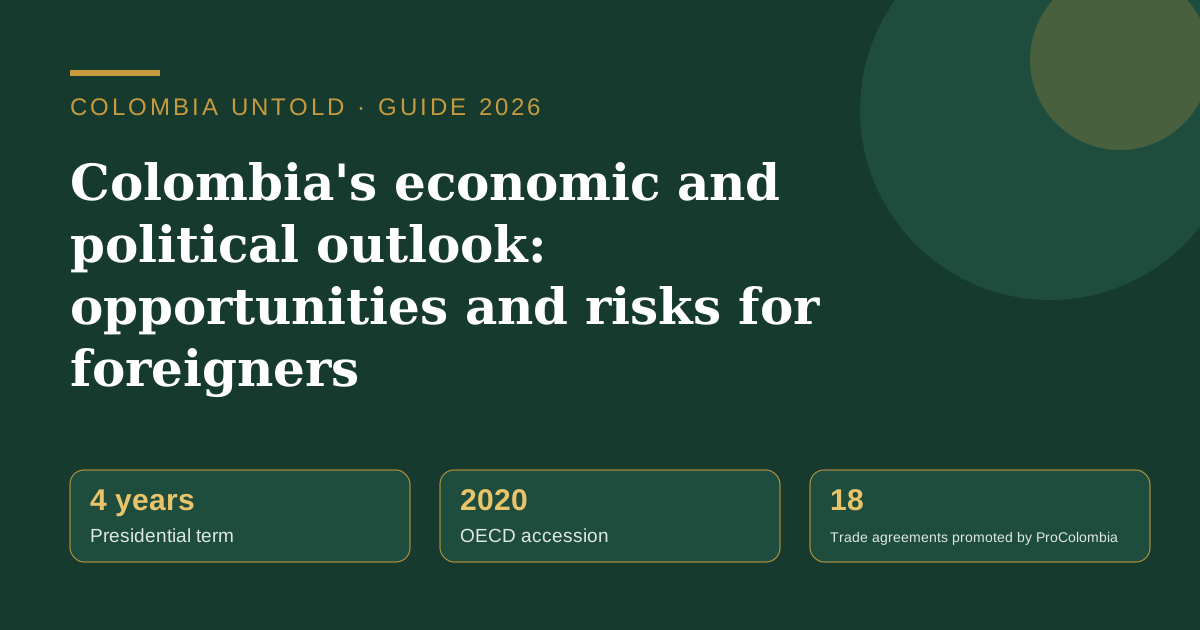
Colombia has an independent central bank, the Bank of the Republic, with an inflation-targeting regime and a floating exchange rate. It has a Financial Superintendence that supervises the system, national accounts run by DANE and a fiscal rule that has been the subject of debate and adjustments. It has been an OECD member since 2020 and has a network of 18 trade agreements promoted by ProColombia. These anchors do not remove risks, but they offer known rules and public information sources that let you follow the country with data. Read What are Colombia's main trade agreements? FTAs with the US, European Union, Canada, Mexico, the UK and South Korea and What competitive advantages does Colombia have over other Latin American countries?.
The political cycle: four-year terms
Colombia's president is elected for four-year terms, without immediate reelection, and the 2026 to 2030 term began on 7 August 2026. Each government arrives with a reform agenda in areas such as taxes, health, pensions, labor, energy and security, which must pass a Congress where majorities are negotiated. For a foreigner, what matters is not the political color but the stability of the rules that affect them: visas, taxes, the exchange regime, foreign investment and property rights. To know what is under discussion at any moment, follow official sources and serious press, and distrust apocalyptic or triumphalist readings.
Reforms: how they affect a foreigner
Tax, labor, health and pension reforms can change rates, contributions, benefits and services. A foreign resident may be affected by changes in income tax, VAT, contributions or the health system. That is why it pays to follow the legislative calendar, review applicable changes when they are approved and consult an accountant or lawyer. Read Taxes in Colombia for foreign residents: guide to tax residence, income tax and VAT and Colombia visa changes 2026: map for expats, investors and retirees. A practical rule: when a reform is announced, do not make irreversible decisions until you know its final text.
Indicators to follow
Four families of indicators summarize the economic situation. First, growth and employment, which DANE publishes as gross domestic product and the unemployment rate. Second, prices, measured by the consumer price index also published by DANE, and the inflation target pursued by the Bank of the Republic. Third, the monetary policy interest rate and the exchange rate, published by the Bank of the Republic and the Financial Superintendence. Fourth, public accounts and debt, reported by the Ministry of Finance. Following these indicators quarterly gives you a sturdier picture than any headline.
The Colombian peso and exchange-rate risk
The peso's exchange rate against the dollar and other currencies has shown historical volatility, influenced by commodity prices, global monetary policy, risk appetite and domestic news. For a foreigner with income in hard currency, a weak peso makes local life cheaper; for someone investing in pesos who wants to exit in dollars, the risk is the reverse. Do not try to guess the rate: design your plan to withstand different scenarios, keep reserves in the currency of your obligations and consider hedges if the exposure is large. Read Money stress and the exchange rate and Sending money to Colombia: fees.
Inflation and cost of living
Inflation affects rent, food, transport and services, and is a central topic in residents' lives. Rental contracts are usually adjusted with reference to a price index, and minimum wages are updated every year. In 2026 the monthly legal minimum wage is COP 1,750,905. Compare your expenses with the city's cost of living and review price developments in DANE's official publications. Read Cost of Living in Medellín 2026: Complete Breakdown and Cost of Living in Bogotá 2026.
Sectors with opportunities
Sectors that often appear in investment conversations include tourism, services and technology, agribusiness, energy and the energy transition, health, creative industries, foreign trade and real estate. Each has its own cycle, regulation and competition, and none is free of risk. For a sector-by-sector analysis, read Business opportunities in Colombia for foreigners: sectors, routes and risks. For those considering real estate, read Buying property in Colombia as a foreigner: complete step-by-step guide.
Security: a nuanced reading
Security in Colombia is heterogeneous: the experience in large tourist cities differs from that of regions with armed groups or illegal economies. Authorities in several countries publish travel advisories that are updated, and they are worth consulting. For a resident, security is managed with local information, good practices and good judgment. Avoid generalizations, in both directions. Read Personal safety for foreigners in Colombia and Neighbourhood safety checklist for foreigners.
Inequality, informality and social challenges
Colombia faces challenges of inequality, labor informality and regional gaps, which influence politics, consumption and social stability. For a foreigner, this translates into a market with very different segments, differences in services between cities and regions and an intense public debate on the development model. Understanding these dynamics helps you invest and live with respect and realism, and avoid the naivety of the tourist or the paternalism of the newcomer.
Main risks for foreigners
The risks most often mentioned are regulatory and tax risk, because of the frequency of reforms; exchange-rate risk, because of peso volatility; fiscal risk, because of the deficit and debt level; security risk in certain areas; infrastructure and logistics risk in some regions; climate risk; and political risk, because of polarization. None is exclusive to Colombia, and all can be managed with diversification, local advice and scenarios. A plan without identified risks is a plan without analysis.
Structural opportunities
The opportunities most often mentioned are the geographic location with access to two oceans, the trade-agreement network, a broad domestic market, human talent in cities with services and technology ecosystems, biodiversity and tourism, a regulated financial system and a track record of integration with bodies such as the OECD. These advantages are not automatic, but they offer a base on which to build businesses and life projects. Read What competitive advantages does Colombia have over other Latin American countries?.
How to build scenarios for your decision
A simple method: define your decision, for example buying an apartment, moving with your family or investing in a business. Identify the three variables that affect it most, such as the exchange rate, interest rates and a specific reform. Describe a favorable, a base and an adverse scenario. For each, calculate how much your result changes and whether you can bear it. Define warning signals that would make you review the plan and a liquidity reserve for the adverse scenario. This exercise, which takes an afternoon, avoids most impulsive decisions.
What international institutions say
Bodies such as the OECD and the World Bank publish periodic analyses on Colombia, with diagnoses and recommendations. They are valuable sources because they combine cross-country comparable data and peer review, though their conclusions change over time. Read them as a complement to local data, not as a verdict. Also consult serious economic press, and distinguish between news, opinion and projections.
For residents: how to protect your situation
Keep your immigration documents current, organize your taxes, keep reserves in the currency of your obligations, diversify your assets, take out health and life insurance, and stay in touch with your embassy or consulate. Read Consulates and Embassies in Colombia: Which to Contact and Healthcare in Colombia for foreigners: EPS, prepaid plans, private policies and international insurance. A financial cushion and a contingency plan are more useful than any forecast.
Common mistakes when assessing the country
Relying on a single source, assuming what happens in one city happens in the whole country, extrapolating a one-quarter trend, believing return promises because of the macro context, ignoring the exchange rate, not distinguishing opinion from data and deciding out of fear or euphoria. An honest analysis recognizes that Colombia offers real opportunities and real risks at the same time.
A monthly watch list
To avoid depending on headlines, spend one hour a month reviewing five sources: the latest Bank of the Republic statement on rates, the latest DANE inflation and employment report, the representative exchange rate, legislative news on reforms that affect you and one serious news source. Write three lines on a sheet: what changed, whether it alters any of your critical variables and whether it triggers any of your warning signals. After six months you will have your own series that tells you more than any opinion.
Our analysis
Colombia offers foreigners a mix of structural opportunities and short-term risks that are better managed with information than with intuition. Our methodological recommendation is simple: follow official indicators, separate the structural from the short-term, build scenarios and do not make irreversible decisions based on a headline. If your plan includes property in Medellín, Medellín Advisors and Premium Propiedades can accompany you with local market information; to sort out your visa, Colombia Visa Legal; and to cover your health in any scenario, CoVisas and Protege Tu Viaje.
Frequently asked questions
Is Colombia's economy stable?
Colombia has an independent central bank, an inflation-targeting regime and a diversified economy, but also fiscal, exchange-rate and security challenges. For a current reading, consult DANE and Bank of the Republic indicators.
When did the current presidential term begin?
The 2026-2030 presidential term began on 7 August 2026. Presidents are elected for four years, without immediate reelection.
Which indicators should I follow?
Growth, unemployment and inflation (DANE), interest rates and the exchange rate (Bank of the Republic and Financial Superintendence) and public accounts (Ministry of Finance).
What is the main risk for a foreign investor?
It depends on the project. The most cited are regulatory and tax changes, peso volatility, the fiscal deficit and security in certain areas. They are managed with advice, diversification and scenarios.
Can my immigration or tax situation change with a new government?
Rules can be adjusted through reforms or decrees.
Is it a good time to invest in Colombia?
No source can give you that general answer. It depends on your goal, horizon, currency and risk tolerance. Evaluate scenarios with official data and independent advice.
Who is in the current presidential term?
The 2026–2030 term began on 7 August 2026.
How is public power organized in Colombia?
Into three branches (executive, legislative and judicial) and autonomous oversight bodies, under the 1991 Constitution.
What is the Banco de la República?
It is the autonomous central bank in charge of monetary and exchange policy.
What is inflation and where is it measured?
It is the general rise in prices, measured by DANE through the CPI (IPC).
What is DANE?
The National Administrative Department of Statistics, which publishes official figures.
How does the exchange rate evolve?
It fluctuates with domestic and external factors.
What political risks exist?
Regulatory, tax and security changes. Follow official sources.
What is a tax reform?
Laws that modify taxes.
What does sovereign rating mean?
It is rating agencies' assessment of the State's ability to pay.
What opportunities exist?
Investment, tourism, renewable energy and services, among others.
What impact does the oil price have?
Colombia exports oil, so its price affects fiscal revenue and foreign currency.
What is the OECD and its role?
Colombia has been a member since 2020; the organization promotes policy standards.
How does politics affect my visa?
Immigration rules can change.
Where do I follow official figures?
At DANE, the Banco de la República and the Ministry of Finance.
Is it a good time to invest?
It depends on your profile and horizon.
What is Colombia's capital?
Bogotá, which is also the largest city and the country's political and economic center.
What is Colombia's currency?
The Colombian peso (COP), issued by the Banco de la República.
What is GDP?
It is Gross Domestic Product, the measure of the value of goods and services produced in the country, published by DANE.
What is the monetary policy interest rate?
It is the rate set by the Banco de la República that guides lending rates in the economy.
What is the trade balance?
It is the difference between the country's exports and imports of goods.
What is the fiscal deficit?
It is the gap when the State spends more than it collects, financed with debt.
What is unemployment and how is it measured?
It is the percentage of people without a job who are looking for work, measured monthly by DANE.
What is the pension reform?
It is the law that changed the Colombian pension system, with changes to the public and private regimes.
What is the peace process?
These are the negotiations and agreements between the State and armed groups to reduce violence, whose progress varies with each government.
Where can I get advice to invest in real estate in Medellín?
Medellín Advisors and Premium Propiedades advise foreign investors in Medellín.
If you are evaluating housing or investment, Medellín Advisors can guide you on search, title review and the purchase or rental process. Always hire independent legal review.
Key figures and data
| Item | Value | Note |
|---|---|---|
| Presidential term | 4 years | No immediate reelection; the 2026-2030 term began on 7 August 2026 |
| OECD accession | 2020 | Colombia joined the organization in 2020 |
| Trade agreements promoted by ProColombia | 18 | With access to over 1,500 million consumers, per ProColombia |
| 2026 minimum wage (SMMLV) | COP 1,750,905 | Reference for visa and investment thresholds |
Official sources and reliable reading
Related guides
- What is changing for foreigners living in Colombia in 2026
- Mercure visa: cases
- Foreigner ID card and R transfer 2026
General information based on current rules and practice; it may change. Confirm your case with the official source or an authorized professional. Not legal, tax or medical advice.