Most foreigners only remember their embassy when something goes wrong: a passport is lost, there is an accident, a detention or the death of a relative. And that is when they discover they do not know where it is, what it can do for them, what documents it needs or what things simply are not its job. Knowing in advance the role of your embassy or consulate reduces stress in a crisis and keeps you from asking for what it cannot give. This guide explains the difference between an embassy and a consulate, the usual services, what to expect in emergencies, what they do not do, how they relate to Colombia's Foreign Ministry and what to prepare before anything happens.
Embassy and consulate: the practical difference
The embassy represents the foreign state before the Colombian government and handles political and diplomatic relations; in Colombia almost all are in Bogotá. The consulate serves the citizens of its country and handles procedures and consular protection. In Bogotá, the consular section usually works inside the embassy or in a separate office; in other cities such as Medellín, Cali or Cartagena, some countries keep consulates or honorary consuls with more limited functions. Always ask which services are provided at the office in your city and which only in Bogotá. The legal basis of consular assistance is the Vienna Convention on Consular Relations of 1963, which recognizes the function of protecting nationals in the receiving state and helping them, within the limits of local law.
The usual services
Travel documents. Passport renewal or replacement, and emergency documents or safe-conducts when you lose your passport and must return home. Timelines and fees depend on each country. Notarial acts and certificates. Powers of attorney, sworn statements, legalizations and signatures, certified copies and life or survival certificates for pensioners. Some services are virtual; others require an in-person appointment. Civil registry. Registration of births, marriages and deaths of nationals abroad, which allows passing nationality to children born in Colombia when your country's law provides for it. Ask about deadlines, because some countries limit the transmission of nationality if it is not registered in time. Registration of nationals. Many embassies offer to register your stay so they can contact you in emergencies or disasters. Information and guidance. Travel alerts, safety information, lists of lawyers, translators and doctors, and emergency contacts. Voting and civic services. Registration to vote from abroad and procedures for military service or electoral registration, depending on the country. Third-country visas. If you need a visa to travel to a country in the region or beyond, the respective embassies in Bogotá handle applications.
Emergencies: what your consulate does
In an emergency, call the local authorities first: the number is 123 for police, ambulance and fire service. Then contact your consulate. Consular emergency lines operate after hours in many countries. Lost or stolen passport. File a report with the Police, request a replacement document or safe-conduct, and notify Migración Colombia if you hold a visa or stay permit. Having digital copies of the passport, the visa and the entry stamp speeds up the process. See Colombian foreigner ID card (cédula de extranjería): what it is, who needs it, requirements, costs and how to apply if you also lost the ID card. Detention or arrest. You have the right to have your consulate notified without delay, under article 36 of the Vienna Convention. The consulate can visit you, check your detention conditions, facilitate contact with your family and give you lists of lawyers. It cannot intervene in the court case, demand your release, or pay bail or fees. Accidents and serious illness. The consulate can help contact your family, advise on medical centers and coordinate with your insurer. It does not pay medical expenses or evacuations. That is why it is crucial to have insurance with health and repatriation cover; see Joining an EPS as a foreigner: requirements, costs and how the health system works for the local system. Death of a national. The consulate assists the family with certification, transport or repatriation of remains and communication with authorities. Costs fall on the family or the insurer. Crises and disasters. In serious events, the embassy can issue alerts, channel information and, in extreme cases, coordinate evacuations. Registering in advance makes it easier to find you. Crime victims. The consulate advises on reporting, medical care and psychological support, and communicates with your relatives. See ATMs in Colombia: withdrawing cash safely, fees, limits and common scams and Dynamic keys in Colombian banks: what they are, how to activate them, what to do without a local number and how to avoid fraud to prevent fraud.
What your consulate cannot do
It cannot give you a residence or work permit in Colombia: that is decided by Colombia's Foreign Ministry and Migración Colombia. It cannot pay your debts, fines, hospital or return ticket, although it sometimes offers conditional repatriation loans. It cannot get you out of jail or change a sentence. It cannot act as a lawyer or interpreter. It cannot exercise authority over the Colombian justice system. And it cannot help in private disputes, such as a lease disagreement or a commercial dispute, although it can give you lists of lawyers. Being clear about this limit avoids frustration.
Apostille and legalization of documents
A common mistake is asking the embassy to apostille a Colombian document. In Colombia, the apostille of Colombian public documents is done by the Foreign Ministry, through its apostille and legalization service, and applies to documents to be used in Hague Convention countries. Conversely, to use documents from your country in Colombia, the apostille is done in your home country. Some foreign documents also require an official translation. These steps are fundamental for marriages, visas and school enrollment; see Marrying a Colombian: legal process, documents and the spouse visa step by step and School calendar in Colombia: calendar A and B, enrollment, holidays and planning with children.
How to prepare your relationship with the embassy before a crisis
Register your stay if your country offers the service. Save in your phone and in the cloud the consular emergency number, the embassy address and opening hours. Keep digital copies of the passport, visa, foreigner ID card, insurance and emergency contacts. Share with a relative or friend a folder with those documents. Check your passport's validity months in advance, because renewal at the consulate can take weeks. Subscribe to your foreign ministry's travel alerts. Know the embassy's route and hours, which may include closures for holidays of both countries.
Safety and travel alerts
Foreign ministries publish security alerts on regions and risk situations. Consult them before traveling within Colombia, together with the Colombian government's recommendations. Border zones and some rural regions may have restrictions; use travel insurance with medical assistance. Colombia Untold partners such as Protege Tu Viaje offer quotes with discounts of up to 65%.
Residence and procedures that do not depend on your embassy
Your visa and foreigner ID card depend on the Foreign Ministry and Migración Colombia. Your embassy can certify documents from your country but cannot process the visa. If you need immigration support, the recommended partners are Colombia Visa Legal and CoVisas. On tax matters, see Tax residency certificate in Colombia: who is resident, how to request it from the DIAN and what it is for; in relation to the consulate, some embassies issue residence or nationality certificates for treaty purposes.
Pensioners and life certificates
Retirees who collect a pension from their country usually have to prove periodically that they are alive. Many countries accept life certificates issued by their consulate, by a Colombian notary with an apostille or by digital means. Find out your paying agency's procedure and schedule the renewal before the deadline to avoid suspensions.
Frequent mistakes
Waiting for an emergency to look for the consulate. Not having copies of documents. Assuming the embassy pays medical expenses or bail. Confusing the apostille in Colombia with that of your country. Going without an appointment. Asking for intervention in private matters. Not telling your family your details. Traveling without medical and repatriation insurance.
What to bring to a consular appointment
Original passport, copy, recent photographs when required, proof of payment of fees, completed forms, supporting documents and, for minors, the presence or authorization of both parents. Arrive early, comply with the premises' security rules and ask whether they accept card payment. Ask whether the procedure can be done by mail or online.
A practical example: passport stolen on a Friday night
Imagine your bag is stolen on a Friday at ten at night. First, block cards and phone from another device. Second, report the theft at a Police station and ask for a copy. Third, write to your country's consular emergency line with your details and digital copies. Fourth, on Monday ask for an appointment for the replacement document and notify Migración Colombia. That order, rehearsed in advance, turns a crisis into a procedure.
Add two more precautions. Keep a small amount of emergency cash separate from your wallet, so that a theft does not leave you stranded, and save the address of a trusted hotel or friend where you can stay while the replacement document is processed. If your embassy is closed for the weekend, many consular sections publish an after-hours number that is answered by a duty officer; knowing it in advance means you do not waste the first critical hours searching the internet on a phone with a low battery.
Frequently asked questions
Can my embassy give me a visa for Colombia?
No. Visas for Colombia are granted by Colombia's Foreign Ministry. Your embassy only certifies documents from your country and provides consular assistance to its citizens.
What do I do if I lose my passport in Colombia?
File a report with the Police, contact your consulate for a replacement document and notify Migración Colombia if you hold a visa or stay permit. Digital copies speed the process.
Can my consulate pay a lawyer or bail?
No. It can give you a list of lawyers and check your detention conditions, but it does not cover fees or bail.
Where do I apostille a Colombian document?
At Colombia's Foreign Ministry, through its apostille and legalization service. Your country's embassy does not apostille Colombian documents.
Can I register my child born in Colombia as a citizen of my country?
It depends on your country's nationality law. Many allow consular registration of birth, with their own deadlines and requirements. Consult your consulate as soon as possible.
What do I do in a serious emergency?
Call 123 first for immediate care and then your consulate. Notify your insurer and your family, and keep the documentation of the event.
Key figures and data
| Item | Value | Note |
|---|---|---|
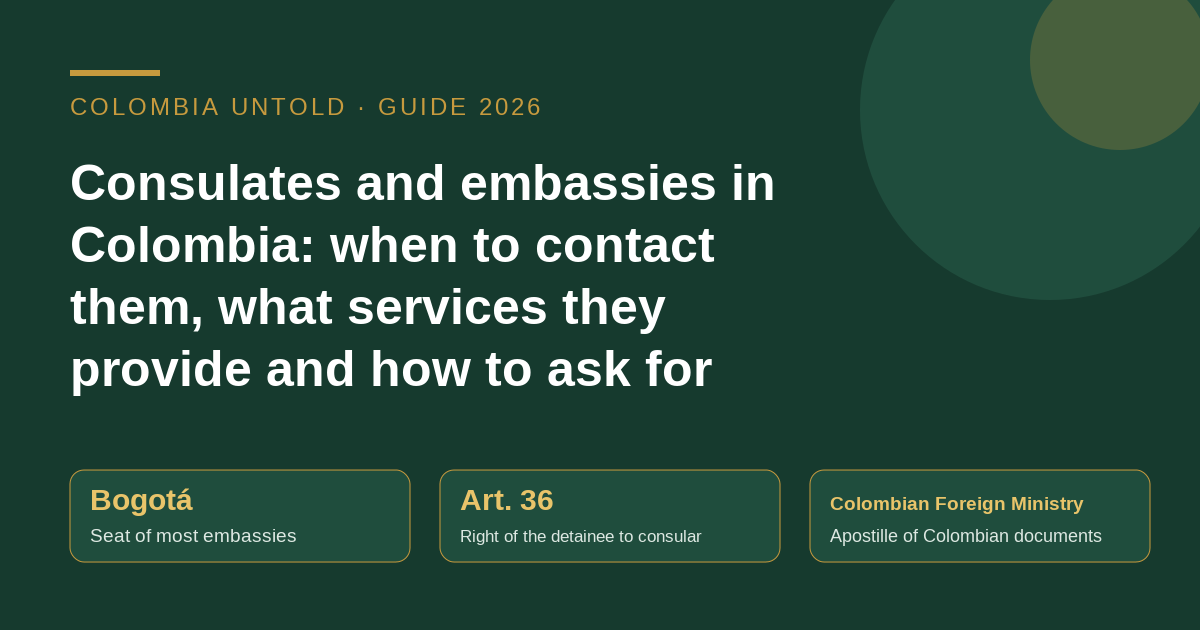
| Seat of most embassies | Bogotá | With consulates in other cities depending on the country |
| Right of the detainee to consular notification | Art. 36 | Vienna Convention on Consular Relations of 1963 |
| Apostille of Colombian documents | Colombian Foreign Ministry | Not your embassy |
| Emergency line | 123 | For immediate risk, call local authorities first |
Official sources and reliable reading
Related guides
General information based on current rules and practice; it may change. Confirm your case with the official source or an authorized professional. Not legal, tax or medical advice.