Magnitude 7.4 earthquake in Colombia (10 August 2026): figures, government response and what expats and travelers should know
Updated: 13 October 2026 · Colombia Untold
Quick answer: On 10 August 2026, at 7:34 a.m., a magnitude 7.4 Mw earthquake (depth 103 km, epicenter in San José del Palmar, Chocó, per the Colombian Geological Survey) shook western Colombia and was felt in 16 departments. As of 21 August the UNGRD reported 321 deaths, 4,595 injured, 31,445 homes destroyed and 163,884 damaged. President Abelardo De La Espriella, who took office on 7 August, ordered a Unified Command Post, and an economic, social and ecological emergency of 30 days was later decreed (Decree 1261 of 19 August).
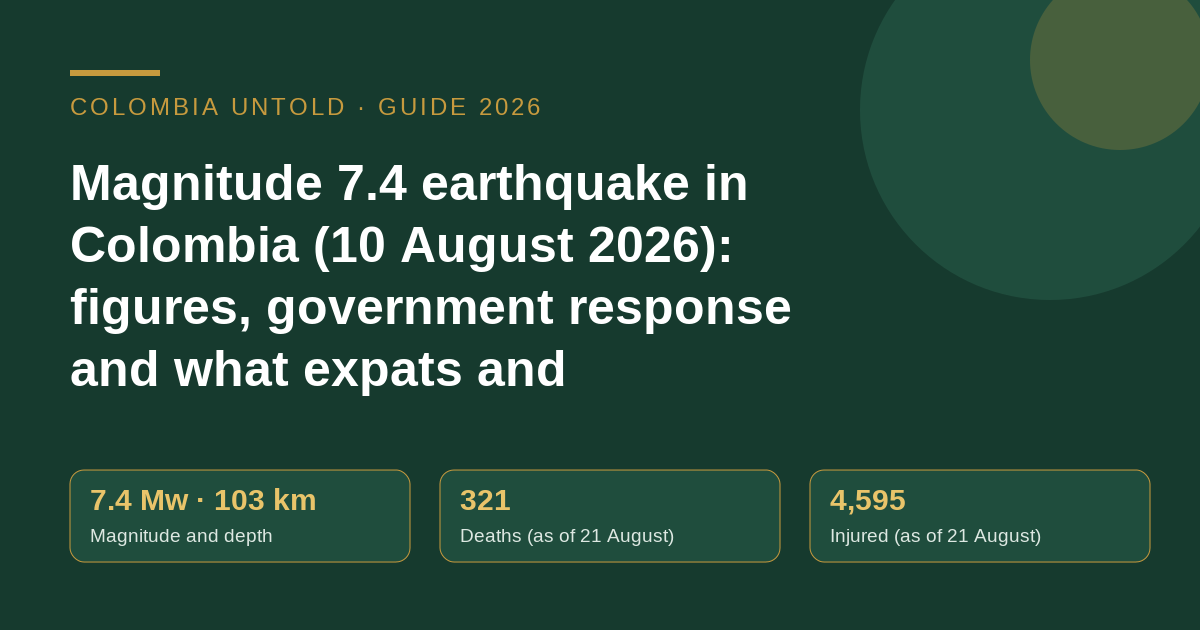
On Monday, 10 August 2026, three days after President Abelardo De La Espriella took office for the 2026-2030 term (he was sworn in on 7 August in Cali), a magnitude 7.4 earthquake shook western Colombia. It was the new government's first big test and an event that changed the country's agenda. This note gathers the figures published by official and press sources, explains the institutional response and offers a practical guide for expats, travelers and investors who live in or plan to travel to Colombia.
What happened
According to the Colombian Geological Survey (SGC), the quake struck at 7:34 a.m. on 10 August 2026, with magnitude 7.4 Mw, a depth of 103 km and its epicenter in San José del Palmar, Chocó. The SGC described it as the strongest recorded in the country in the last decade, and it was felt in 16 departments, according to the PAHO/WHO Situation Report. The first press reports mentioned a lower preliminary magnitude; the 7.4 Mw figure was confirmed by the SGC and the USGS. It was also felt in parts of Ecuador. Preliminary damage was reported in Pereira (Risaralda), Cali, Armenia and Manizales, as well as in Valle del Cauca municipalities such as Riofrío and Vijes.
Damage toll
The UNGRD published a toll with a cut-off of 6:30 a.m. on 21 August 2026: - Deaths: 321. - Injured: 4,595. - Homes destroyed: 31,445. - Homes damaged: 163,884. - Animals rescued: 1,254. The figures rose progressively: the cited report mentions 288 deaths on 14 August and 289 on 16 August. Another press source, citing the emergency decree, gathered somewhat different figures for earlier dates (314 deaths, 4,437 injured, 262 missing and 262,154 people affected), with 302 collapsed buildings and damage to 352 health centers and 3,470 schools. Those differences are explained by the date cut-offs, so for any formal use you should consult the latest UNGRD toll. The SGC recorded more than 325 aftershocks since 10 August, concentrated in Chocó, according to the 21 August toll.
How the new government responded
- First day: the president ordered a Unified Command Post (PMU), asked the UNGRD director for a detailed report of needs and announced his trip to Pereira. His message: "You are not alone. The State is present and acting." - Departments: the Valle del Cauca governorate activated its own PMU to assess municipalities. - Declaration: media reported the declaration of a national-level disaster. - Economic emergency: Decree 1261 of 19 August 2026 declared a State of Economic, Social and Ecological Emergency for 30 days, citing a public calamity that exceeds the immediate capacity of local entities and the Nation. Among the measures described by the press are faster procedures for external public credit operations, temporary use of assets managed by the SAE for shelters and aid storage, expansion of Works for Taxes to affected municipalities, alternative spaces and remote education when schools cannot operate, and the possibility for financial cooperatives to offer credit and services to non-member victims. This summary comes from the press; the binding text is in the official decree.
Is it safe to travel to Colombia?
The most affected area is the west (Chocó and the central-western Andes), while much of the country continues operating normally. The prudent recommendation for a traveler is: - Check the status of airports, roads and services in the destination city before booking. - Avoid areas with restrictions or reported damage and follow local authorities' instructions. - Buy travel insurance with medical and cancellation coverage. You can get quotes with [Protege Tu Viaje](Protege Tu Viaje), with up to 65% off, checking exclusions for natural disasters. - Register your presence with your consulate; see Consulates and embassies in Colombia: when to contact them, what services they provide and how to ask for help. If your route includes the Coffee Region (Pereira, Manizales, Armenia), verify the local situation with official sources; for a city overview see Climate by city in Colombia: thermal zones, rain, altitude and how to choose where to live and The 10 best cities to live in Colombia: climate, altitude, cost, culture and how to choose with a scoring matrix.
What resident expats should do
- Confirm your and your family's safety and notify your embassy or consulate.
- Check your home: cracks, gas leaks and structure before reoccupying it if there was damage.
- Keep your documents in digital and physical copy in a safe place; see Digital document backup for expats.
- Verify your health and housing coverage. See Table: travel insurance vs visa medical plan and Joining an EPS as a foreigner: requirements, costs and how the health system works.
- If your visa or procedure has deadlines and you faced force majeure, keep evidence and consult an adviser; read Visa requirement notification and Migración Colombia appointment and biometrics: how to book, what to bring and how to avoid improper charges.
Investors and owners
If you own or plan to buy property, the event is a reminder of three points: check compliance with the earthquake-resistant construction code, verify home and earthquake insurance, and ask a professional for an inspection before buying. For the general process, see Buying property in Colombia as a foreigner in 2026. In Medellín, [Medellín Advisors](medellinadvisors.com) and [Premium Propiedades](premiumpropiedades.com) can accompany you in due diligence. For related migration matters, [Colombia Visa Legal](colombiavisalegal.com) and [CoVisas](covisascolombia.com) can guide you.
Illustrative reading of the figures (own arithmetic)
With the 21 August toll, homes destroyed plus damaged add up to 195,329 (31,445 + 163,884). Destroyed homes represent about 16% of that total (31,445 ÷ 195,329 = 16.1%). That calculation shows that most of the damage was in damaged homes that need assessment and repair, not only reconstruction.
Hypothetical cases
Case 1. A digital nomad in Medellín notes that the quake was felt, but his building had no damage; he confirms with the administration, reviews his policy and keeps his emergency kit. Case 2. A couple with a trip booked to the Coffee Region consults their airline and insurer, and decides to postpone. Keeping the documentation lets them claim under the policy. Case 3. An investor about to sign the purchase of an apartment asks for a structural inspection before going on. He gains time and peace of mind.
How to follow reliable information
- Colombian Geological Survey for quakes and aftershocks. - UNGRD for tolls and shelters. - Migración Colombia and the Foreign Ministry for procedures. - PAHO/WHO for public health reports. Avoid sharing social media figures without a source.
Checklist
- Family located and contact with consulate.
- Home reviewed by a professional if there was damage.
- Documents in digital and physical copy.
- Health and home insurance verified.
- Trips to affected areas reviewed with airline and insurer.
- Emergency kit ready. See Earthquake preparedness in Colombia: family plan, emergency kit, insurance and what to check in your home.
Summary timeline of the first days
- 7 August: President Abelardo De La Espriella sworn in at Cali, for the 2026-2030 term. - 10 August, 7:34 a.m.: 7.4 Mw quake with epicenter in San José del Palmar, Chocó. The same day a Unified Command Post is set up and the trip to Pereira is announced. - 14 and 16 August: tolls recording 288 and 289 deaths, respectively. - 19 August: Decree 1261, declaring the economic, social and ecological emergency for 30 days. - 21 August, 6:30 a.m.: UNGRD toll with 321 deaths and 4,595 injured. - September: PAHO/WHO continues publishing situation reports (number 8 has a cut-off of 11 September). This timeline is limited to facts cited by the sources; for later events, consult the official channels.
Impact on tourism, flights and services
An event of this scale usually affects tourism supply and logistics in nearby areas, while other regions keep operating. If you have bookings, ask your airline, hotel or insurer about change and cancellation policies, and keep all communication in writing. For migration procedures and leaving the country, see Is Colombia stricter with visitors in 2026? Inadmission figures, causes and how to travel without problems and Check-Mig Colombia: what it is, when to fill it in and why it is not a visa.
What the country learned: risk management and construction
The tolls of damaged and destroyed homes reopen the discussion on compliance with the earthquake-resistant code, maintenance of older buildings and urban planning. For a resident or investor, the practical lesson is to document the state of the property, keep insurance up to date and know the building's protocols.
Support for affected communities
If you want to help, prefer established channels such as the Colombian Red Cross and official campaigns, and be wary of unverified fundraising on social media. Verify the organization, the account and the purpose before donating, and keep the receipt. If you are a resident, local volunteer groups can also be reached through your neighborhood or city hall.
What this means for your plans
If you were planning to move, invest or travel, the practical approach is to wait for official confirmation about the destination, keep flexible bookings and review your insurance. Most of the country continues working, and informed decisions are better than rushed ones.
Complementary emergency guide
This note focuses on consolidated figures, the government's response and the impact on expats, travelers and investors. For immediate step-by-step guidance (what to do, how to help and emergency contacts) see our [earthquake emergency guide](/en/news/colombia-earthquake-2026-emergency-guide/), published in the first days after the quake, and the [earthquake preparedness](/en/news/earthquake-preparedness-expats-colombia/) guide to organize your family plan.
Frequently asked questions
What was the magnitude of the 10 August 2026 earthquake?
7.4 Mw according to the Colombian Geological Survey, at 7:34 a.m., with a depth of 103 km and its epicenter in San José del Palmar, Chocó.
How many victims did it cause?
As of 21 August the UNGRD reported 321 deaths and 4,595 injured; the figures were updated in the following days.
What measures did the government take?
President De La Espriella ordered a PMU on day one, a national disaster declaration was reported and Decree 1261 of 19 August declared an economic, social and ecological emergency for 30 days.
Is it safe to travel to Colombia?
Much of the country operates normally, but you should check the status of your destination area and buy travel insurance.
Does my insurance cover earthquakes?
It depends on the policy. Check natural disaster exclusions and cancellation coverage before buying.
Where can I see updated official information?
On the SGC website for quakes, the UNGRD for tolls and PAHO/WHO for situation reports.
If you need a medical plan or travel insurance for your visa or stay, CoVisas Colombia can guide you on plans that meet Resolution 5477. Always compare the coverages in writing.
Key figures and data
| Item | Value | Note |
|---|---|---|
| Magnitude and depth | 7.4 Mw · 103 km | Colombian Geological Survey, 10 August 2026, 7:34 a.m. |
| Deaths (as of 21 August) | 321 | UNGRD toll reported by NTN24 |
| Injured (as of 21 August) | 4,595 | UNGRD toll reported by NTN24 |
| Homes destroyed / damaged | 31,445 / 163,884 | UNGRD toll, as of 21 August |
Official sources and reliable reading
- PAHO/WHO – Situation Report 8: Colombia, August 2026 earthquake
- NTN24 – New UNGRD toll: 321 dead and 4,595 injured
- Vanguardia – Economic emergency after the 7.4 quake (Decree 1261)
- Publimetro – The president spoke after the 7.4 earthquake
- Colombian Geological Survey
- UNGRD – National Disaster Risk Management Unit
Related guides
- Earthquake preparedness in Colombia: family plan, emergency kit, insurance and what to check in your home
- Magnitude 7.4 earthquake in Colombia (10 August 2026): figures, government response and what expats and travelers should know
- Earthquake preparedness in Colombia: family plan, emergency kit, insurance and what to check in your home
General information based on current rules and practice; it may change. Confirm your case with the official source or an authorized professional. Not legal, tax or medical advice.