Climate by city in Colombia: thermal zones, rain, altitude and how to choose where to live
Updated: 13 October 2026 · Colombia Untold
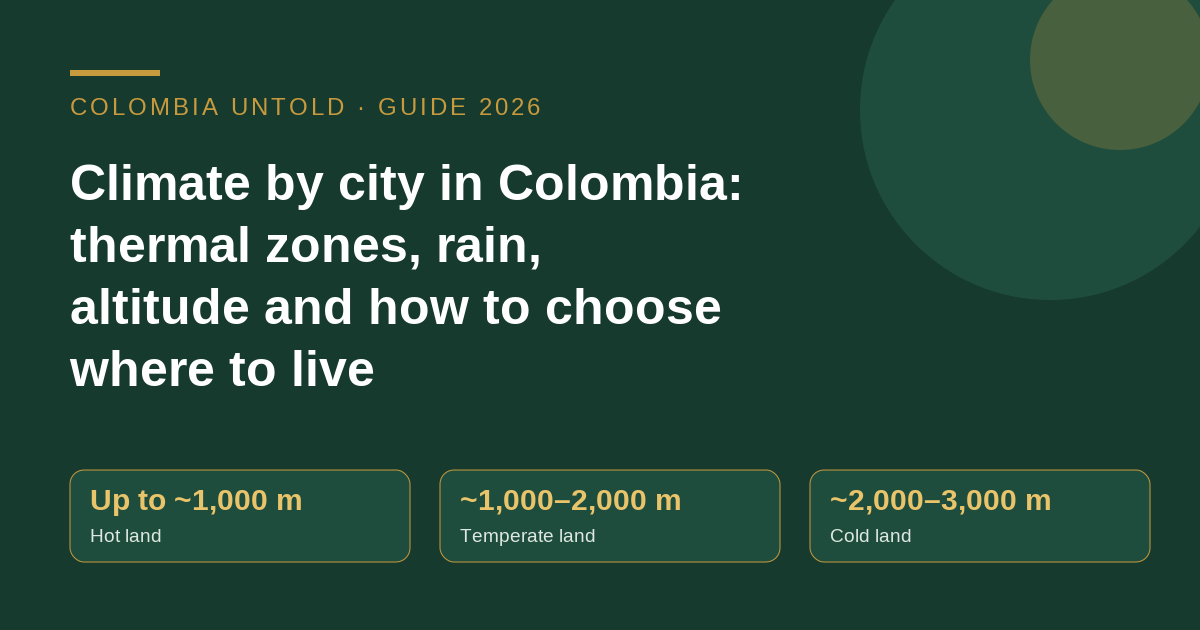
Quick answer: In Colombia, climate depends mainly on altitude, not seasons: hot land (up to ~1,000 m: Cartagena, Barranquilla, Santa Marta), temperate land (1,000–2,000 m: Medellín, Cali, Coffee Region), cold land (2,000–3,000 m: Bogotá, Tunja) and páramo (over 3,000 m). Medellín averages around 22 °C and Bogotá around 14 °C (approximate values). There are rainy and dry seasons that vary by region; check the IDEAM forecast before deciding.
If you come from a country with four seasons, it helps to unlearn one idea: in Colombia there is no winter or summer in the classic sense. What changes the climate is altitude. In the same country you can live at 28 °C by the sea or at 14 °C in an Andean capital. This guide explains the thermal zones, the rainy seasons, the effect of altitude on the body and how to choose a city according to your tolerance, health and way of working.
The thermal zones
- Hot land (up to about 1,000 m): heat and humidity all year, as in Cartagena, Barranquilla and Santa Marta. Average temperatures usually range from 27 to 30 °C (approximate values). - Temperate land (1,000 to 2,000 m): spring-like climate, as in Medellín, Cali, Pereira and the Coffee Region. Medellín usually averages around 22 °C. - Cold land (2,000 to 3,000 m): cool climate, as in Bogotá and Tunja. Bogotá usually averages around 14 °C, with cold mornings and nights. - Páramo (over 3,000 m): cold and wind, with little permanent population. Figures are approximate and vary by neighborhood and year; always check IDEAM for current data. Bogotá's altitude is around 2,600 m, Medellín's close to 1,500 m and Cali's close to 1,000 m.
Rain and seasons
In the Andean region there are usually two rainier seasons per year, roughly between March and May and between September and November, with drier periods between December and February and mid-year. On the Caribbean coast, the dry season tends to concentrate early in the year and heavy rain in the second half. El Niño and La Niña phenomena can alter these patterns, so there are no fixed dates. Check the IDEAM forecast before planning trips or moves.
Most common cities for foreigners
Medellín. Temperate climate almost all year, popular among nomads and retirees. See Medellín vs Bogotá for expats: climate, cost, work, paperwork, neighborhoods and how to decide. Bogotá. Cool, large and with a bigger corporate and cultural offer; needs layered clothing. Cali. Warmer than Medellín, with afternoon breezes. Cartagena and Santa Marta. Constant heat and humidity, with beaches and tourism. Coffee Region. Pleasant climate and coffee landscapes, with frequent rain. For an overview of cities see The 10 best cities to live in Colombia: climate, altitude, cost, culture and how to choose with a scoring matrix.
Altitude and the body
In high cities such as Bogotá, some people notice fatigue, headache or difficulty sleeping during the first days, known as altitude sickness or soroche. It is usually mild and eases with rest, hydration and avoiding intense effort on arrival. If you have heart or respiratory conditions, consult your doctor before traveling. Insurance with medical care is useful; you can get quotes with [Protege Tu Viaje](Protege Tu Viaje), with up to 65% off, checking coverage. See also Joining an EPS as a foreigner: requirements, costs and how the health system works and Pharmacies and medicines for foreigners in Colombia.
What to pack
- High-altitude cities: layers, a light jacket, a raincoat and sunscreen, because radiation is high even when it is cold.
- Temperate land: light clothing for the day and a layer for the night, plus an umbrella.
- Coast: cool clothes, a hat, sunscreen and repellent.
Housing and climate
Check humidity, ventilation, sun orientation and noise before renting. On the coast, air conditioning is almost essential; in Bogotá, heating is rare and homes can feel cold. In temperate land, natural ventilation is usually enough. Before signing, read Checklist before signing a lease in Colombia: clauses, maximum rent, increases, guarantees and red flags and How to negotiate a lease in Colombia as a foreigner: rent, co-signer, policy, term, increases and what the law does not allow. If you buy property in Medellín, [Medellín Advisors](medellinadvisors.com) and [Premium Propiedades](premiumpropiedades.com) can help.
Remote work and climate
Connectivity and power cuts do not depend only on weather, but heavy rain can affect service. Keep an internet backup and see Power cuts and UPS for remote work in Colombia: rights, compensation, runtime calculation and backup plan and Fiber internet in Colombia: how to choose a plan, speed, router, Wi-Fi, backup and what to ask before contracting. To plan workspaces see Coworking and cafés for remote work in Colombia.
Illustrative comparison example (own arithmetic)
Between an average of 14 °C in Bogotá and 22 °C in Medellín there is an 8 °C difference (22 − 14). Between Medellín and a coastal city at 28 °C there are another 6 °C (28 − 22). Those jumps explain why clothing, air-conditioning energy use and even the pace of life change from one city to another. These are reference values, not forecasts.
Hypothetical cases
Case 1. A retiree with joint problems prefers Medellín's temperate climate because constant cold worsens her discomfort. Case 2. A nomad who hates heat rules out the coast and chooses Bogotá, accepting cool nights and traffic. Case 3. A family tries three weeks in a city before renting for a year and finds that humidity affects them more than expected.
How to decide
- Define your comfortable temperature range. - Consider your health and altitude. - Spend at least two weeks in the city before committing. - Visit in different seasons if you can. - Assess the cost of energy and air conditioning. Plan your budget with Budget for your first 90 days in Colombia: method, template, worked example, buffer and mistakes and Cost of living for expats in Colombia 2026.
Checklist
- IDEAM forecast reviewed.
- City altitude and acclimatization plan.
- Layered clothing and raincoat.
- Insurance and medical care identified.
- Housing with adequate ventilation.
- Trial of at least two weeks before a long-term contract.
A typical day by city
Bogotá. Cool mornings, often with a jacket; the midday sun warms, but as the afternoon falls the temperature drops fast. Go out with layers and a small umbrella. Medellín. Mild mornings, warm middays and pleasant afternoons; afternoon showers are frequent in rainy seasons. Cartagena. Heat and humidity from early on; outdoor activities concentrate in the morning and at dusk, and air conditioning sets the routine. Coffee Region. Cool-temperate climate, with morning mist and frequent rain; enjoyed with light clothing and a raincoat.
How climate affects your budget (own arithmetic)
Suppose (hypothetical case) an apartment where air conditioning uses about 150 extra kWh a month and a kWh costs $900. The extra expense would be $135,000 per month (150 × 900). Over a year it would be $1,620,000. If in temperate land you do not need air conditioning, that expense disappears. These are illustrative figures: check your real bill and your utility's rates before deciding.
Climate, health and lifestyle
Climate influences sleep, mood, allergies and joints. People with asthma or rhinitis may notice changes with humidity or with pollution in big cities; people with arthritis usually prefer less cold climates. Before moving, ask your doctor and try the city for a few days. To bring medication to Colombia see Pharmacies and medicines for foreigners in Colombia and, if you travel with a pet, Bringing your pet to Colombia: ICA requirements, vaccines, health certificate, flight, quarantine and first steps.
Activity plans by climate
- Temperate climate: hiking, cycling, parks and terraces almost all year. - Cold climate: museums, gastronomy, culture and weekend escapes to hot land. - Coast: beach, diving and water sports, with sun protection and hydration breaks. For hobby ideas see Sports and hobbies for expats in Colombia: bike days, mountains, tejo, diving, dance, safety and insurance.
Climate safety and emergencies
Heavy rain can cause landslides and floods in vulnerable areas, and fire or drought seasons can affect air quality in some regions. Before choosing housing, consult the city hall's risk maps, avoid unstable slopes and stream beds, and save emergency numbers. Subscribe to alerts from IDEAM and local risk management. Keep a basic kit with a flashlight, water and document copies.
A 14-day acclimatization plan
- Days 1 to 3: rest, hydrate and avoid alcohol and strenuous effort if you arrive in a high city.
- Days 4 to 7: resume your work routine and light exercise; adjust your wardrobe.
- Days 8 to 10: explore neighborhoods at different times to understand sun, rain and noise.
- Days 11 to 14: decide whether the climate suits you before signing a long contract. Read Checklist before signing a lease in Colombia: clauses, maximum rent, increases, guarantees and red flags.
Frequent myths about Colombian climate
- "Colombia is always hot." False: Andean cities are temperate or cold, and only low-lying areas are hot.
- "Medellín is the city of eternal spring, with no rain." It has rainy seasons with heavy showers; carrying an umbrella is normal.
- "Altitude doesn't affect you if you're fit." It can affect anyone, although it is usually mild.
- "There is no rain on the coast." There is a marked rainy season toward the second half of the year.
How to find reliable data
Use the IDEAM site for forecasts and alerts, your city hall's site for risk maps and the Ministry of Health for health recommendations. Avoid relying only on generic weather apps, because they may not reflect mountain microclimates well.
Final advice
Before deciding where to live, combine three sources: official data, the experience of residents and your own two-week trial. That combination avoids disappointment and improves your adaptation.
Useful questions before moving
- At what altitude is the neighborhood where I will live?
- How are the ventilation and humidity of the home?
- Which transport system is near me and how does rain affect it?
- Is there a clinic with international care nearby?
- Is the neighborhood on a slope or near a stream that could be risky in heavy rain?
Frequently asked questions
Are there seasons in Colombia?
Not as in temperate climates. There are rainy and dry seasons that vary by region, and climate is mostly defined by altitude.
Which city has a spring-like climate?
Medellín is famous for its temperate climate, with averages around 22 °C (approximate value).
Is Bogotá cold?
Yes, it is a cool city with averages near 14 °C (approximate value), and nights and early mornings are cold.
What is soroche?
It is discomfort caused by altitude; it is usually mild and improves with rest and hydration. Consult your doctor if you have prior conditions.
When does it rain most?
In the Andean region, roughly between March and May and between September and November, with variations from El Niño and La Niña.
Where do I check the official forecast?
On the IDEAM website.
If you want guidance on migration requirements, you can contact Colombia Visa Legal. When a procedure is online, Cancillería recommends doing it directly; professional guidance helps you understand the process, it does not replace the official source.
Key figures and data
| Item | Value | Note |
|---|---|---|
| Hot land | Up to ~1,000 m | Cartagena, Barranquilla, Santa Marta |
| Temperate land | ~1,000–2,000 m | Medellín, Cali, Coffee Region |
| Cold land | ~2,000–3,000 m | Bogotá, Tunja |
| Páramo | Over 3,000 m | Cold and wind |
Official sources and reliable reading
Related guides
- Is Colombia stricter with visitors in 2026? Inadmission figures, causes and how to travel without problems
- Foreigner ID card duplicate
- Table: travel insurance vs visa medical plan
General information based on current rules and practice; it may change. Confirm your case with the official source or an authorized professional. Not legal, tax or medical advice.