Civil status change and your Colombian visa: marriage, de facto union, divorce or widowhood and what you must report
Updated: 13 October 2026 · Colombia Untold
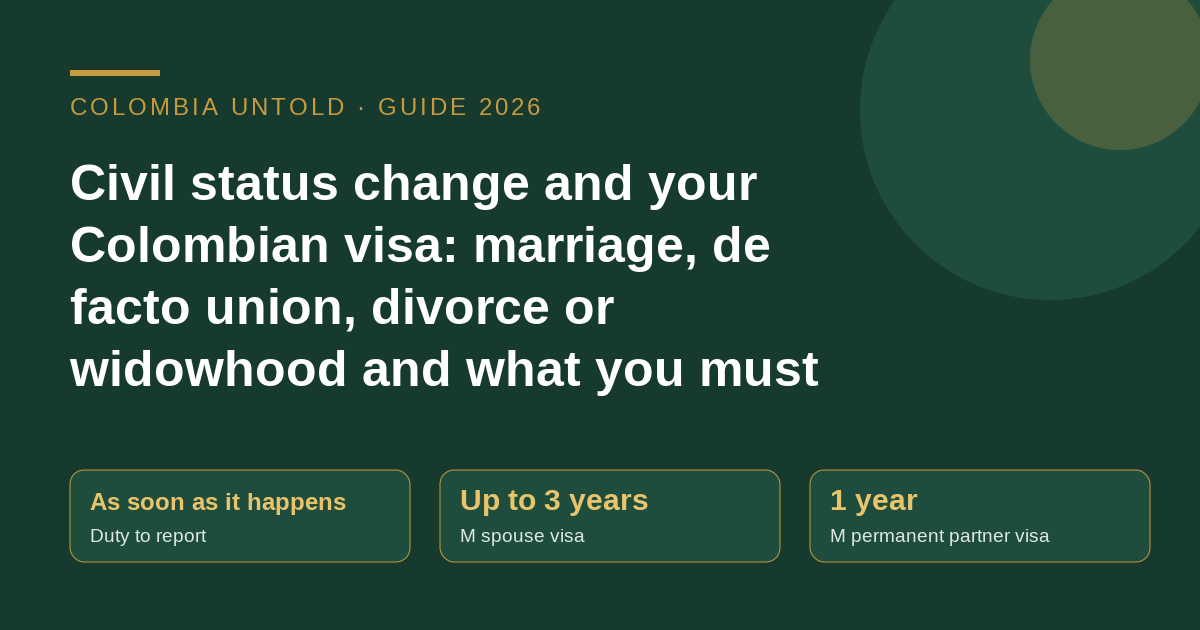
Quick answer: If your civil status changes (you marry, formalize a de facto union, separate, divorce or become widowed), Resolution 5477 of 2022 requires reporting the change of circumstances to the visa authority as soon as it occurs (art. 3). A visa that depends on a bond, such as the spouse visa or a beneficiary visa, may lose its basis. Marrying a Colombian opens the M spouse category, which requires a Colombian marriage civil record, a cohabitation letter and migration movement certificates for both.
Life changes and papers have to keep up. Marrying, living with a partner, separating or losing a spouse are personal events with immigration consequences: they can open a new visa category, put your current one at risk or change who may be a beneficiary of it. This guide explains what Colombian rules say, what you must report and how to organize documents in each situation.
The central rule: report the change of circumstances
Article 3 of Resolution 5477 of 2022 defines change of circumstances and establishes that the holder must inform the visa and immigration authority as soon as it takes place. A civil status change fits that duty when it affects the basis on which the visa was granted. Failing to report can leave you with a visa whose foundation no longer exists, and Article 8, paragraph 4, warns that any inaccuracy in the form data is grounds for denial or inadmission. Transparency, besides being an obligation, protects your status.
If you marry a Colombian
Marriage to a national opens the M spouse category. According to the Cancillería, you need the Colombian marriage civil record issued in the previous three months, a letter from the Colombian spouse declaring effective cohabitation, a special power of attorney if the foreigner applies through an attorney and migration movement certificates for both. The visa is valid for up to three years, grants an open work permit and allows you to accumulate time toward residence. The full detail is in Marriage visa in Colombia (M spouse visa) 2026: requirements, documents, validity, work rights and the path to residence. If the marriage took place abroad, it must be registered in Colombia to obtain the civil record the Cancillería asks for. That means apostilling the marriage certificate and translating it if it is not in Spanish, following the chain described in Apostille and translations for Colombian visas 2026: the legalization chain, official translators and mistakes that stall your file. The registration process is explained in Civil registry for foreigners in Colombia: birth, marriage and death, apostille, translation and children's nationality.
If you formalize a de facto union
The de facto marital union is regulated by Law 54 of 1990 and is declared by the means set by law, for example a public deed before a notary or conciliation. Resolution 5477 includes the category of permanent partner of a Colombian national within the M visas, valid for one year under Article 68. The evidentiary requirements for cohabitation are demanding, so it is wise to gather supporting documents in advance and get advice on what support the authority accepts. The Constitutional Court, in ruling SU-214 of 2016, recognized marriage between persons of the same sex in Colombia, so same-sex couples can access the spouse categories on equal terms with others.
If you are a beneficiary of your partner's visa
The Resolution provides that spouses or permanent partners who are economic dependents of the principal holder can be beneficiaries of their visa. If you are a beneficiary and the relationship ends, your visa loses its basis and you must review how to regularize your situation through your own route, such as an activity visa (work, study, investment) or another category you meet. Do not wait for the visa to expire: act as soon as the situation changes and ask for guidance. For the overview of family visas see Family and partner in the migration file.
If you separate or divorce
Divorce or legal separation does not automatically cancel the visa, but it does change the basis of an M spouse visa or a beneficiary visa. The prudent course is to report the change of circumstances to the authority, keep the procedure documents (divorce ruling or deed, annotated civil records) and evaluate with a lawyer which category you can keep or request. If you have been a holder for years, check whether you can access a category that recognizes your time of stay, such as R resident in one of its routes; see From expat to permanent resident: the R visa in Colombia, routes, required years and ID card. As for how to divorce, in Colombia the divorce of a civil marriage can be processed before a notary when there is mutual agreement or before a family judge in other cases. If the divorce was decreed abroad, its recognition in Colombia usually requires a judicial exequatur procedure; consult a family lawyer before assuming the civil status change in Colombian records.
If you become widowed
The death of the Colombian spouse or of the principal holder is also a change of circumstances that you must report. Gather the death civil record, apostilled and translated if foreign, and check whether your category lets you stay or whether you must request another. Widowhood situations are sensitive; an adviser can help you organize documents and not lose status while you grieve.
How your civil identity is updated in Colombia
Civil status is proven with the birth civil record with the corresponding annotations (marriage, divorce, death). For foreigners who have a Colombian civil record, for example through a child, or who marry in Colombia, the Registraduría and notary offices handle the registration. The cédula de extranjería and other immigration documents are updated at Migración Colombia; see Colombian foreigner ID card (cédula de extranjería): what it is, who needs it, requirements, costs and how to apply and, if you change your name through marriage or divorce, remember that passport, visa and cédula data must match.
Children, names and documents
If the civil status change involves a surname change on your passport, align everything: passport, visa, cédula de extranjería, contracts and bank accounts. A discrepancy between names causes returns in procedures, blocks at banks and delays at airports. For children, review their civil record and, if they travel with only one parent, the guide Exit authorization for minors leaving Colombia: when it is needed, who signs it, validity and what to do if a parent refuses.
Frequent mistakes
- Marrying abroad and assuming the marriage already counts in Colombia without registering it.
- Ceasing to live together and keeping a spouse visa without reporting the change.
- Declaring on the form a civil status that is no longer true.
- Changing surname on the passport without updating the visa and cédula.
- Not keeping apostilled rulings, deeds and civil records.
Checklist by case
- Marriage: civil record, apostille and translation, cohabitation letter, power of attorney if applicable.
- De facto union: deed or conciliation and proof of cohabitation.
- Divorce: ruling or deed, exequatur if foreign, change-of-circumstances report.
- Widowhood: death record and category review.
- Any case: update passport, visa and cédula, and keep digital copies.
When to ask for support
Civil status changes mix family, immigration and sometimes property law. A professional can help you order the steps and deadlines. You can consult [Colombia Visa Legal](colombiavisalegal.com) or [CoVisas](covisascolombia.com). If you are in transition and need short-term medical coverage, [Protege Tu Viaje](Protege Tu Viaje) offers plans with up to 65% off.
Three hypothetical situations
These are illustrative examples, not real cases.
A couple who marry and want to keep working. A person with a work visa marries a Colombian. They are not obliged to change category if their current visa remains valid and their job continues, but they can evaluate the spouse visa for its open work permit and because it does not depend on an employer. What matters is to report the change of circumstances and not let the current visa expire while processing the new one.
A beneficiary who separates. Someone entered as a beneficiary of their partner's visa and the relationship ends. Their priority is to find out how much time the visa has left and which own category they can meet: employment contract, study or investment. The sooner they look for a route, the lower the risk of becoming irregular.
A divorce decreed abroad. A person divorced in their home country and wants it reflected in Colombian records. They need the ruling apostilled and translated and, very probably, a judicial recognition procedure before the civil status is annotated. In the meantime they must be consistent on all forms with the true legal situation.
Action plan in 30, 60 and 90 days
- First 30 days: report the change of circumstances, gather certificates, rulings and records, and check your visa's expiry date. - Days 31 to 60: apostille and translate foreign documents, consult a lawyer about the most suitable category and prepare the new file if applicable. - Days 61 to 90: file the application with margin, update passport, cédula and contracts, and keep a digital copy of everything. This calendar is our own organizing guide, not a legal deadline. Official deadlines depend on each procedure and authority.
What to always keep
Keep in a digital and a printed file your passport, visa, cédula de extranjería, civil records with their annotations, rulings or deeds, cohabitation letters and filing receipts. Having these documents in order reduces response time when an authority asks for a clarification and prevents a procedure from stalling over a paper you cannot find. The guide Digital document backup for expats explains how to back them up.
Frequently asked questions
Must I inform the authorities if I marry or divorce?
Article 3 of Resolution 5477 of 2022 requires reporting the change of circumstances to the visa authority as soon as it occurs, especially when it affects the basis of your visa.
Will I get a visa for marrying a Colombian?
You can apply for the M spouse visa, valid for up to three years with an open work permit, meeting the documents the Cancillería requests.
Is my beneficiary visa still valid if I separate?
Its basis changes because it depends on the holder. You must report the change and review with an adviser how to regularize through your own route.
How long does the permanent partner visa last?
Article 68 of Resolution 5477 sets a validity of one year for that category.
Does a marriage celebrated abroad count for the spouse visa?
The Cancillería asks for the Colombian marriage civil record, so a foreign marriage must be registered in Colombia, with apostille and translation as applicable.
What happens if I misstate my civil status on the form?
Article 8, paragraph 4, establishes that any inaccuracy in the form data is grounds for denial or inadmission.
If you want guidance on migration requirements, you can contact Colombia Visa Legal. When a procedure is online, Cancillería recommends doing it directly; professional guidance helps you understand the process, it does not replace the official source.
Key figures and data
| Item | Value | Note |
|---|---|---|
| Duty to report | As soon as it happens | Art. 3 of Resolution 5477: change of circumstances |
| M spouse visa | Up to 3 years | With an open work permit, according to the Cancillería |
| M permanent partner visa | 1 year | Validity stated in Article 68 of Resolution 5477 |
| Inaccuracy on the form | Grounds for denial | Art. 8, par. 4 of Resolution 5477 |
Official sources and reliable reading
Related guides
- Migración Colombia appointments and biometrics
- Family and partner in the migration file
- Visa processing time expectations
General information based on current rules and practice; it may change. Confirm your case with the official source or an authorized professional. Not legal, tax or medical advice.