Pillar
Resident visa transfer 2026: Cancillería extended the deadline to 31 October 2026, who must do it and what happens if you do not
Updated: 13 October 2026 · Colombia Untold
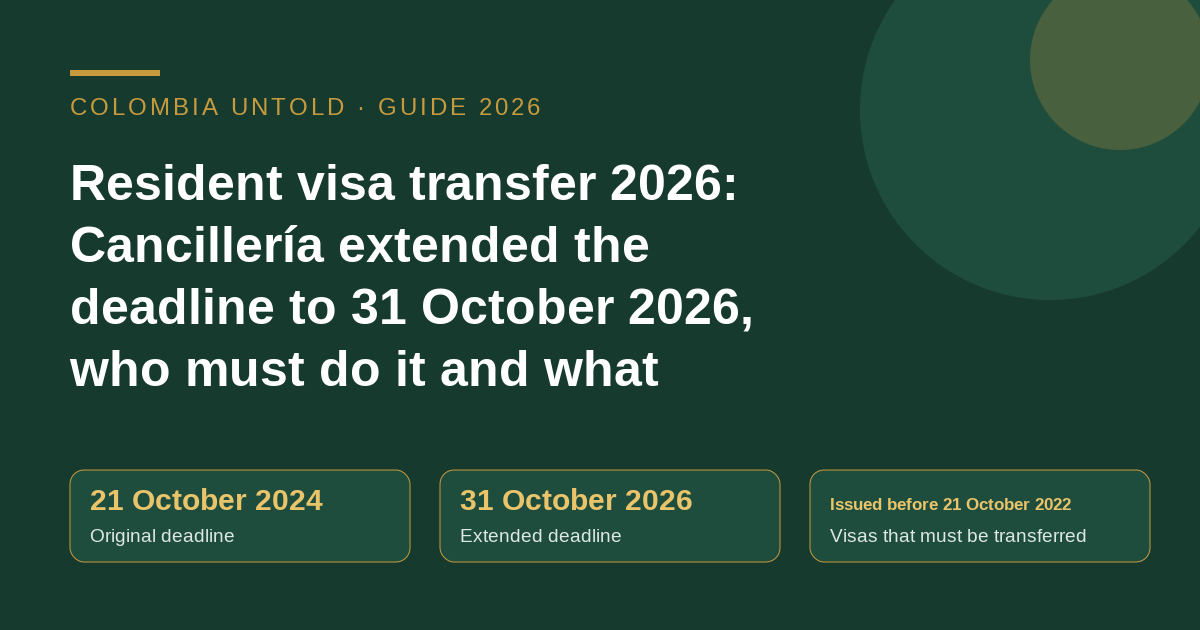
Quick answer: Cancillería extended the deadline for transferring resident visas issued before 21 October 2022: the original deadline was 21 October 2024 and Resolution 9316 of 2024 extended it to 31 October 2026, according to El Tiempo. Holders and beneficiaries of a valid resident visa issued under the previous rules must do it. As of today, 17 October 2026, 14 days remain until that limit (our own arithmetic). Once the transfer is approved, a new cédula de extranjería must be processed.
If you hold a resident visa issued before Resolution 5477 of 2022 took effect, there is a date you must have on your calendar: 31 October 2026. It is the deadline, extended by the Cancillería, to complete the transfer of that document to the new regime. This guide summarizes what was extended, who it affects, what documents are requested, what it costs according to the press, what happens if the procedure is denied and how to organize the final days.
What was extended and when
According to El Tiempo, the original deadline for the transfer was 21 October 2024. The Cancillería extended it through Resolution 9316 of 2024, signed by its secretary general, to 31 October 2026. The extension became public in early October 2024. Since then holders have had two additional years, but the deadline expires in the coming weeks. Our own arithmetic: from 17 to 31 October 2026 there are 14 calendar days. If you count only business days, subtract weekends and holidays: in that span there are fewer than ten business days. This means that if you have not yet filed your transfer, every day counts.
Who must do the transfer
The source states that holders and beneficiaries of a resident visa that is still valid and was issued under the rules prior to Resolution 5477, that is, before 21 October 2022, must do it. Visas issued after that date are already under the new regime. If your visa was issued earlier and you are not sure it is a resident visa, check the visa's sticker or label and see the guide From expat to permanent resident: the R visa in Colombia, routes, required years and ID card and the general Colombia visa types 2026: V, M and R explained, categories, validity, work rights and how to choose.
What the transfer is
The transfer is the procedure by which the visa authority approves or denies reissuing the visa under the current regime, keeping the same nationality with which it was issued. Once reissued, the holder must process a new cédula de extranjería at Migración Colombia. It is not a new visa application for a different category but the update of the one you already have.
Documents mentioned by the press
El Tiempo, in its practical guide, lists these supports: - A copy of the visa and of the cédula de extranjería, together in a single PDF (the cédula need not be valid). - A valid passport with at least six months of validity. - A migration movements certificate from Migración Colombia, covering entries and exits since the last visa. - A signed letter explaining the reason for the transfer, referring to Articles 86 and 123 of Resolution 5477. - A photograph meeting the Cancillería's specifications. - Documents translated into Spanish and apostilled when foreign. - A document stating that the salvoconducto does not apply, because of the transitional regime. For visas issued before the year 2000 when the original visa is not kept, the source mentions a sworn letter, an expanded migration movements certificate and the last cédula issued. To build the chain of foreign documents see Apostille and translations for Colombian visas 2026: the legalization chain, official translators and mistakes that stall your file and Documents for your Colombian visa: what to apostille, what to translate and how to build a file that is not returned.
Cost and payment according to the source
The El Tiempo guide states that the transfer fee is 54 dollars, clarifying in a correction that the 400-dollar figure applies only to those applying for a visa for the first time. Spanish citizens do not pay a visa fee, nor do nationals of Japan, South Korea and Ecuador, and Peruvians living in the Amazon and Putumayo river basins. After approval there are ten business days to pay the issuance; if unpaid, it is considered withdrawal. Check the current fee on the Cancillería portal before paying.
What happens if the procedure goes wrong
According to the same source, if the transfer is inadmitted the procedure ends but you can submit a new application. If the visa is denied, you must leave Colombia within 30 calendar days and cannot apply again for six months, and the new application must be filed from your country of nationality or permanent legal residence. If the file is incomplete and you do not answer a request within 10 calendar days, it may be inadmitted or denied. That is why it is wise to file complete and answer notifications at once; the guide Visa requirement notification explains how to respond.
The cédula de extranjería after the transfer
The new visa does not replace the cédula. Adults, and minors over seven years old with a visa valid for more than three months, must process the cédula de extranjería at Migración Colombia after issuance. See Colombian foreigner ID card (cédula de extranjería): what it is, who needs it, requirements, costs and how to apply and Cédula de extranjería after the R visa transfer in 2026: who needs it, when, what to bring and mistakes that slow the process.
Another change from Resolution 9316
The same resolution, according to El Tiempo, exempts holders of V visas for tourism, business, crew and event visitors, and of certain diplomatic or international-agreement visas, from registration at Migración Colombia and from the cédula de extranjería procedure, regardless of the visa's validity. It does not change the need for the transfer for residents.
Action plan for the days that remain
- Confirm your visa's issue date and whether it is a resident visa.
- Download your migration movements certificate and check your passport (six months of validity).
- Scan visa and cédula into a single PDF and draft the reason letter.
- If there are foreign documents, check their apostille and translation.
- File the transfer on the Cancillería platform and keep the receipt.
- Pay within ten business days after approval.
- When you receive the visa, apply for the cédula de extranjería.
If you will not make it
If you cannot complete the file before the deadline, consult an adviser at once about your visa's situation, because the law provides consequences for those who do not meet the current regime's deadlines. Do not wait to see whether there is another extension: when writing this guide we did not find an extension later than the 31 October 2026 one. You can consult [Colombia Visa Legal](colombiavisalegal.com) or [CoVisas](covisascolombia.com), which guide this kind of procedure.
Frequent mistakes
- Trusting that there will be another extension.
- Presenting a passport with less than six months of validity.
- Uploading documents without apostille or translation.
- Forgetting the letter with the reason for the transfer.
- Letting the ten business days to pay lapse.
- Not processing the cédula de extranjería after approval.
Frequent situations of holders and beneficiaries
Beneficiaries. The press notes that the transfer applies to holders and beneficiaries of resident visas issued before 21 October 2022. If you are a beneficiary, also gather the documents that prove your bond and verify that your application is linked to the correct file. Minors. Minors over seven with a visa valid for more than three months must obtain a cédula de extranjería after the transfer. Plan appointments for the whole family with time to spare. Travel during the procedure. Before leaving the country with a transfer in progress, keep the filing receipt and your passports. Remember the absence rule: the R visa is lost after more than two consecutive years outside Colombia, according to Resolution 5477. Data that do not match. If your name or passport number changed since you obtained the visa, gather the documents that explain it, as detailed in Passport change and your Colombian visa: what happens to your visa if you renew or lose your passport, transfer, nationality and minimum validity.
Schedule for the last 14 days (our own arithmetic)
- Days 1 to 2: confirm your visa requires a transfer and gather visa, cédula and passport. - Days 3 to 5: request the migration movements certificate and, if needed, apostille and translate documents. - Days 6 to 8: draft the reason letter, take the photograph and assemble the single PDF. - Days 9 to 10: file the application and keep the receipt. - Days 11 to 14: answer any request at once; a late reply can close the procedure. This schedule is our own organization: what matters is to file complete before 31 October 2026.
What to keep as evidence
Keep, digitally and on paper, the filing receipt, the Cancillería email, the payment receipt and the reissued visa. If you later need to prove that you complied within the deadline, those documents will be your backup. The guide Digital document backup for expats helps you organize them.
Why acting early still matters
Even if an extension seems possible, the safest assumption is that the date will not move. Filing early gives you room to correct small errors, to respond to a request within the 10 calendar days the Cancillería gives, and to schedule the cédula de extranjería appointment without pressure. Waiting until the last days concentrates every risk into the same short window: a missing apostille, a certificate that takes longer than expected, a platform that is busy or a payment that is delayed. A transfer that is approved but not paid within ten business days is treated as withdrawn, so leave time for that step too.
Frequently asked questions
Until when can I transfer my resident visa?
Until 31 October 2026, under the extension in Resolution 9316 of 2024 reported by El Tiempo.
Which visas must be transferred?
Valid resident visas issued before 21 October 2022 under the previous rules.
How much does the transfer cost?
The press reports a fee of 54 dollars for the transfer; the 400 dollars applies to those applying for a visa for the first time.
What documents are required?
A copy of the visa and cédula in one PDF, a passport with six months of validity, a migration movements certificate, the reason letter, a photograph and apostilled, translated documents if foreign.
What happens if the transfer is denied?
According to the source, you must leave Colombia within 30 calendar days and cannot apply again for six months, and the new application is filed from your country.
Must I get a new cédula de extranjería?
Yes. After reissuance, adults and minors over seven with a visa valid for more than three months must process it at Migración Colombia.
If you want guidance on migration requirements, you can contact Colombia Visa Legal. When a procedure is online, Cancillería recommends doing it directly; professional guidance helps you understand the process, it does not replace the official source.
Key figures and data
| Item | Value | Note |
|---|---|---|
| Original deadline | 21 October 2024 | According to El Tiempo, before the extension |
| Extended deadline | 31 October 2026 | Cancillería Resolution 9316 of 2024, according to El Tiempo |
| Visas that must be transferred | Issued before 21 October 2022 | Valid resident visas under the previous rules |
| Days left as of 17 October 2026 | 14 days | Our own arithmetic: 17 to 31 October |
Official sources and reliable reading
Related guides
- What is changing for foreigners living in Colombia in 2026
- Mercure visa: cases
- Cédula de extranjería after the R visa transfer in 2026: who needs it, when, what to bring and mistakes that slow the process
General information based on current rules and practice; it may change. Confirm your case with the official source or an authorized professional. Not legal, tax or medical advice.