Zipaquirá and its Salt Cathedral: complete guide from Bogotá
Updated: 13 October 2026 · Colombia Untold
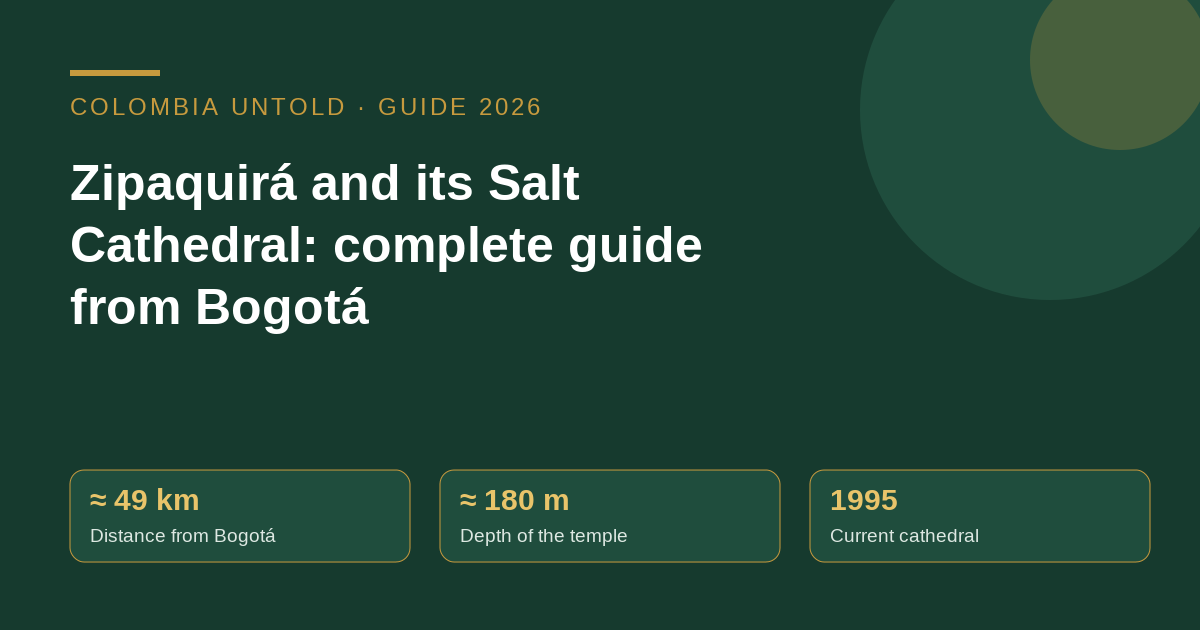
Quick answer: The Zipaquirá Salt Cathedral sits about 49 km north of Bogotá, inside a former salt mine roughly 180 metres underground. You can get there by car, by bus from the Portal Norte station or on the Sabana tourist train; the visit takes two to three hours and is best done early on a weekday.
Some places are understood better from the inside, and the Zipaquirá Salt Cathedral is one of them. Less than two hours from Bogotá, in the municipality of Zipaquirá (Cundinamarca), a Catholic temple, galleries, sculptures and light rooms unfold inside a mountain of salt that the Muisca were already mining centuries before the Spanish arrived. It is one of the most popular visits on the Cundiboyacense plateau, a perfect full-day plan from the capital and, for anyone arriving in Colombia for the first time, a simple way to understand how mining, faith and engineering have shaped the identity of the centre of the country. This guide gathers what you really need to organise the visit: history, how to get there, what you see in each stretch of the route, how much time to set aside, what to eat, how to look after your health at this altitude, what to do in the town and how to combine it with other stops. Prices, schedules and routes change every year, so here we explain the logic and the orders of magnitude and leave exact fares to the official channels of the mine and the town hall.
What the Salt Cathedral is and why it matters
The so-called Salt Cathedral is not a cathedral in the strict ecclesiastical sense; it is a sanctuary or minor basilica excavated in the tunnels of a rock-salt mine, that is, halite, a mineral formed hundreds of millions of years ago when ancient seas covering part of today’s plateau evaporated. The complex sits on Zipaquirá hill, about 2,650 metres above sea level, and the current temple is about 180 metres below the entrance. Its mix of sacred architecture, mining work and light show turned it into a national symbol: in 2007, in a public vote promoted by the press, it was chosen as one of the so-called “Seven Wonders of Colombia”, a popular recognition rather than a title from international bodies. Beyond the title, it matters for three reasons. The first is historical: for centuries Zipaquirá was one of the country’s most important salt sources, a strategic product for preserving food and for trade among Indigenous peoples and later the colony. The second is human: the sanctuary grew out of the daily worship of the miners, who entrusted themselves to the Virgin of the Rosary of Guasá before entering to work in very hard conditions. The third is tourist and economic: the complex is one of the engines of Cundinamarca’s tourism and supports local jobs in guiding, transport, food and crafts.
From Muisca salt to today’s sanctuary: timeline
The Muisca obtained salt by evaporating water from saline springs in clay pots and exchanged it with peoples from other regions for gold, cotton, coca and fruit. With the conquest, exploitation passed to the Crown and then to the republican State; for centuries salt was a monopoly with fiscal value. In the mid-twentieth century the miners dug a small chapel into the galleries, blessed in 1932, as a place of prayer before their shifts. Over time it grew into a sanctuary visited by worshippers and tourists alike. In 1990 the original sanctuary was closed for structural safety reasons, because mining use and visitor flow compromised the galleries. In its place, an architecture competition led to a new temple designed in a deeper sector, with the aim of preserving the tradition while guaranteeing stability. That new Salt Cathedral was opened on 16 December 1995 and has been the complex’s main attraction ever since. Today the park around it, also offers mining-experience tours, a museum, a screening room and food areas.
What the route is like inside
The entrance is a sloping gallery that descends through the mountain. The main route is organised around a Way of the Cross of fourteen stations, each a small chamber or niche with a different cross sculpted in salt rock and bathed in colour-changing light. It is a stretch designed for reflection: you move in a group, with a guide, in a cool, low-light environment with walls that glitter from halite crystals. At the end of the Way of the Cross you reach the three large naves of the temple, symbolically associated with the birth, life and death of Christ, held up by columns carved from the salt itself. In the central nave is the monumental cross excavated in the wall, several metres high and the most photographed image of the complex. The spaces are wide, with capacity for thousands of people, and are used for masses, concerts and special events. The acoustics are remarkable; when there is choral music, the effect is hard to describe. Depending on the ticket type, the route includes other spaces: the Salt Museum, which explains the geological formation and the history of mining; the water mirror, a sheet of salt water that reflects the lights; the screening room or audiovisual show narrating the mine’s history; and the mining experience, where visitors wear helmets and headlamps, get an explanation of drilling and tools and can symbolically extract a piece of salt. It is one of the most educational parts for those travelling with children.
How to get there from Bogotá
There are three main options, with different advantages. - By private or rented car: take the Autopista Norte and the road towards Zipaquirá, with tolls along the way. Without traffic it is about 60 minutes; on weekends and holidays, especially on the way back, it can triple. There is parking near the park entrance. If you do not know the city, use an up-to-date GPS and avoid peak hours leaving and entering Bogotá. - By public transport: from the Portal Norte TransMilenio station, intercity buses to Zipaquirá leave frequently at low prices. The trip takes between 60 and 90 minutes depending on traffic. In Zipaquirá a taxi or city bus takes you to the park; you can also walk up from the town centre in about 20 to 30 minutes along a steep street. - On the Sabana tourist train: the Sabana tourist train route runs on set dates and times, mainly weekends and holidays, with steam or diesel locomotive and period carriages. The trip is slow but scenic, with stops and activities on board. It is a good alternative if you want to make the journey part of the experience; check the current operation on the operating company’s official site. There are also organised tours leaving from Bogotá hotels that include transport, entry and a guide, sometimes combined with Nemocón or Guatavita. They are comfortable if you travel alone or with little time, though you pay for the convenience.
Tickets, schedules and how to organise yourself
The park opens every day, with hours that usually extend on holidays and in high seasons. Tickets can be bought at the box office or online on the official site; on peak dates (Holy Week, December, long weekends) it is wise to buy ahead to avoid long queues and sold-out capacity. There are several options: general entry to the cathedral route, combos including the museum and mining experience, differential rates for Colombian residents, children and older adults, and packages with food. Foreigners generally pay a different rate from the national one; bring your passport or ID to access any discounts that apply. Arrive at least an hour before the box office closes and plan two to three hours inside, more if you add the museum and mining experience. Guided groups leave every few minutes; if you prefer a calmer pace, choose a weekday morning. The first hours of the day and the last of the afternoon are usually the quietest.
Indicative budget for a full day
The following figures are orders of magnitude per person, in Colombian pesos, and serve for planning; actual prices change by season and should be checked on the official channels. - Transport from Bogotá: intercity bus, cheap; organised tour, several times more expensive; own car, fuel plus tolls and parking. - Entry: varies by route type; combos with the mining experience cost more than general entry. - Food: the park has restaurants with set menus and the town offers good food for less; set aside budget for a typical lunch. - Extras: professional photos, salt crafts, an additional guide and tips. A family of four should treat entry as the main part of the budget, as fares multiply per person. Small children usually have reduced rates.
What to see in Zipaquirá besides the mine
The town keeps a pleasant colonial centre, with cobbled streets, white houses and balconies. Plaza de los Comuneros, near the diocesan cathedral, is the social centre, with cafés and ice-cream shops. The Zipaquirá Diocesan Cathedral itself, with its sober façade, deserves a short visit. Salt Park, the food zone and the Salt Village offer crafts and small museums, and there are viewpoints over the valley. A typical lunch includes ajiaco, corn on the cob with cheese, empanadas, almojábanas and the inevitable arequipe and fig sweets. If you have another half day, Nemocón, about 20 minutes away, has another visitable salt mine, smaller and with settings used in audiovisual productions. For a longer trip, Guatavita, the lake of the El Dorado myth, and Tominé reservoir are also close. If you are putting together a wider itinerary, see Itinerario de 7 Días en Colombia (ruta express) (en español) and Bogotá: Guía Completa para Visitantes 2026 (en español).
Best season and best time of day
The climate of the plateau is cool all year, with daytime temperatures of 14 to 20 degrees and colder nights. Inside the mine the temperature is stable and cool, roughly 12 to 16 degrees, with high humidity; bring a light jacket. The rainy seasons, April-May and October-November, do not prevent the visit, because most of it takes place under cover, but they make walking in the town and road traffic less pleasant. Long weekends and the December season are the busiest. For the best experience, choose a working day, arrive first thing and book lunch in town.
Altitude, health and safety on the visit
Zipaquirá sits at about 2,650 metres, a little higher than Bogotá, and the mine requires walking on damp, sometimes slippery surfaces. Those arriving from sea level should acclimatise one or two days beforehand and drink water often; see our guide on Altitude and sleep in Bogotá. People with cardiovascular or respiratory conditions, pregnant women and older adults should consult their doctor before going. The route includes stairs and slopes; there are adapted routes for people with reduced mobility, which should be requested when buying the ticket. Wear closed shoes with a good sole. Those with claustrophobia may feel uncomfortable in narrow stretches, although the cathedral itself is a wide space. In terms of safety, the complex is well guarded and low risk. The normal precautions of any tourist destination still apply: look after phones and wallets in town, use formal transport and do not accept street tour offers from people without ID. See Estafas Comunes en Colombia y Cómo Evitarlas (en español) and ¿Es Seguro Viajar a Bogotá en 2026? Guía Honesta (en español) for general recommendations.
Travel insurance and planning
If you are visiting, travel insurance with medical and evacuation cover handles surprises from altitude discomfort to a fall on a trail. You can get quotes with discounts of up to 65% at Protege Tu Viaje. If you will also stay beyond a few months, your migration status is a key piece of the plan: review the requirements in Requisitos de Entrada a Colombia por Nacionalidad 2026 (en español) and, for long-term visas, in Colombia Visa Types: A Complete Explained Guide.
A one-day itinerary that makes the most of your time
Leave Bogotá early, around 7:00, to reach Zipaquirá before 9:00. Visit the park first, before the large groups arrive, and devote the morning to the cathedral route and the museum. At midday go down to the town, have lunch at a traditional restaurant and walk around the square. In the early afternoon, stop at the Diocesan Cathedral or the viewpoint. If there is time, finish with a short visit to Nemocón or return to Bogotá before 16:00 to avoid return traffic. This plan works well without a car and is a good first outing outside the city for those still adapting to the altitude.
How to combine the visit with other plans
You can add Zipaquirá to a two- or three-day route across the plateau: Bogotá, Zipaquirá, Guatavita and Villa de Leyva. You can also pair it with a cultural plan in the capital with museum visits, as explained in Bogotá museums visitor. If you travel with children, take advantage of the mining experience, which mixes play and learning; see Viajar a Colombia con Niños: Guía Familiar (en español).
Frequently asked questions
Is the Zipaquirá Salt Cathedral an active church or just a tourist attraction?
It is both. The sanctuary remains a place of Catholic worship, with masses on set dates, normally Sundays, and during the rest of the week it works as a tourist attraction. Respect is expected: low voices, decorous clothing and silence at the stations of the Way of the Cross.
How much time do I really need, and is it worth doing as a day trip from Bogotá?
Including transport, the full plan takes between six and eight hours. Inside the park two to three hours are recommended; the rest is travel, lunch and a stroll through the town. It is a very feasible day trip, and it is better to give it the whole morning so as not to rush.
Is it suitable for people with mobility problems or small children?
Yes, with preparation. There are adapted routes and they can be requested when buying the ticket, but the route includes descents and steps. Small children usually enjoy the mining experience; for babies a folding stroller is recommended, and avoid times of heavy crowds.
Can I go without a tour, on my own?
Yes. The cathedral route is done with guided groups included in the ticket, so you do not need an outside tour. Public transport from the Portal Norte is simple and cheap; a tour only adds convenience for the transfer.
What is not allowed inside the mine?
For safety and conservation, tripods, drones and flash are restricted in some stretches, as is eating and drinking inside the temple and touching or scratching the salt walls. Follow staff instructions and do not leave the guided group.
What is the difference between the Zipaquirá Salt Cathedral and the Nemocón mine?
Zipaquirá combines a monumental sanctuary with a museum and mining experience; Nemocón is a smaller mine with galleries, underground lakes and settings with mining and film history. Zipaquirá is the main visit; Nemocón complements it if you have time and a taste for geology.
If you need a medical plan or travel insurance for your visa or stay, CoVisas Colombia can guide you on plans that meet Resolution 5477. Always compare the coverages in writing.
Key figures and data
| Item | Value | Note |
|---|---|---|
| Distance from Bogotá | ≈ 49 km | About 60 to 90 minutes by road depending on traffic |
| Depth of the temple | ≈ 180 m | Inside a halite mine at 2,650 m above sea level |
| Current cathedral | 1995 | Opened on 16 December 1995; the first miners’ chapel dates from 1932 |
| Recommended visit length | 2 to 3 hours | Not counting the trip from Bogotá |
Official sources and reliable reading
Related guides
General information based on current rules and practice; it may change. Confirm your case with the official source or an authorized professional. Not legal, tax or medical advice.